

描述
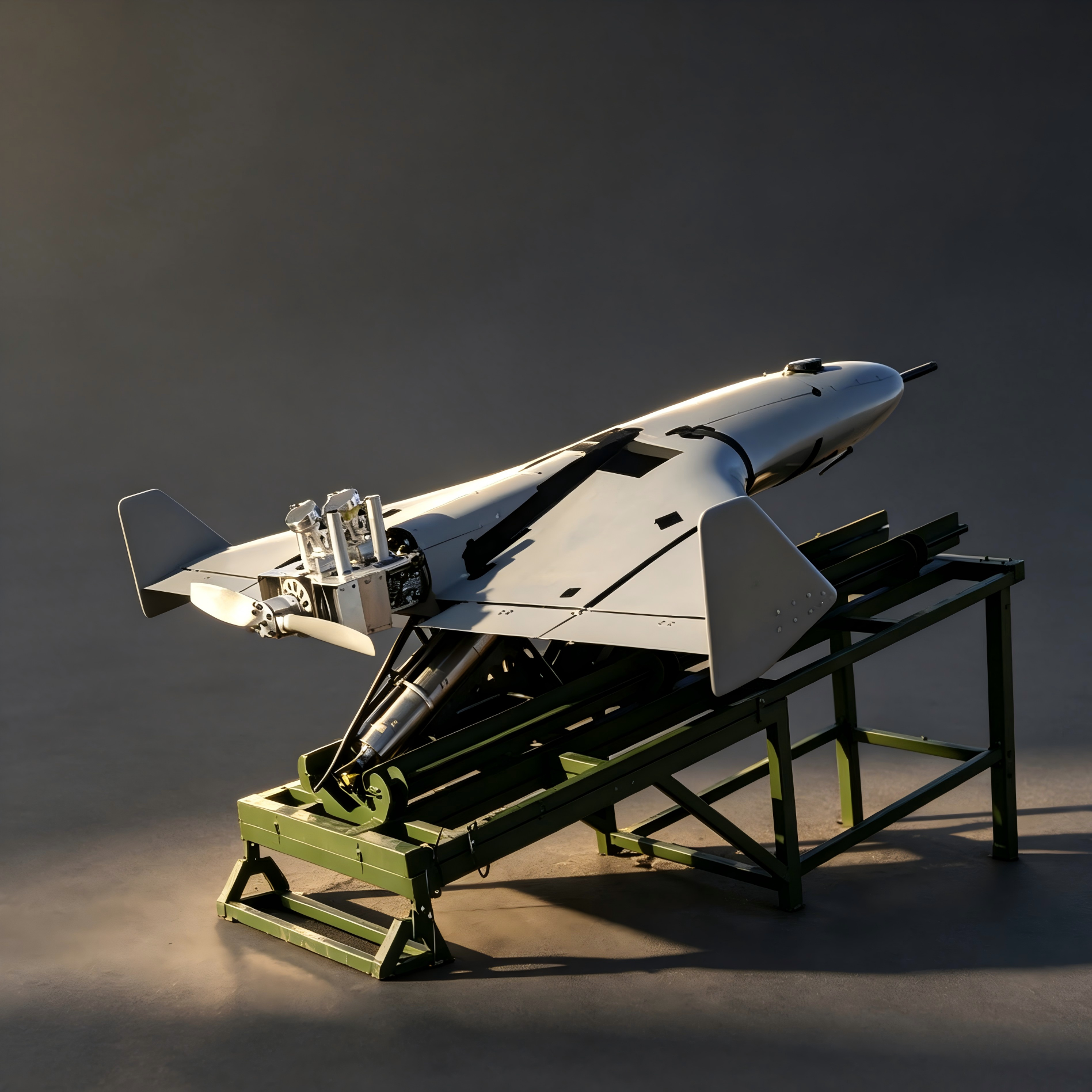
The “Little Motorcycle” tri-wing suicide drone is equipped with a civilian motorcycle engine, a wooden propeller, and a high-explosive warhead weighing approximately 50 kilograms, yet it can strike targets across a vast area spanning 1,500 to 2,500 kilometers. It represents a unique type of “patrol missile” —combining reconnaissance capabilities with precision strike capability—capable of hovering over target areas in wait-and-see mode and launching a dive attack upon detecting a target.
Key advantages include: Extreme cost-effectiveness – the manufacturing cost per unit is so low that it even surpasses that of certain luxury motorcycles; Extended range – with a maximum range of 1,500 to 2,500 kilometers, sufficient to cover strategic targets; Swarm tactics – combining low-altitude, slow-speed flight with swarm saturation attacks, placing enemy air defense systems in a predicament where detection is difficult, interception costly, and resource-intensive; Simple mass production – capable of large-scale manufacturing at standard mechanical plants, breaking down the barriers inherent in traditional military industry.
key parameter :
Dimensions and Weight: The aircraft measures approximately 3.5 meters in length, has a wingspan of about 2.5 meters, and weighs around 200 kilograms.
Warhead: A high-explosive warhead weighing 40 to 50 kilograms, with a yield equivalent to that of a 155-mm howitzer shell;
Powertrain: A civilian piston engine mounted on a motorcycle, propelled by a rear-mounted propeller, with a cruising speed of approximately 185 km/h;
Guidance system: Inertial Navigation System (INS) combined with civilian GPS/GLONASS satellite navigation; later models are equipped with anti-jamming devices to counter electronic suppression.
Noise characteristics: During flight, it emits a distinctive two-stroke engine hum, resembling that of a motorcycle in the air, hence its name.
1. Product Overview
2. Technical Specifications
| No. | Indicator | Parameters |
|---|---|---|
| 1 | Fuselage Length | 3600mm |
| 2 | Wingspan | 2800mm |
| 3 | Maximum Take-off Weight | 180kg |
| 4 | Maximum Effective Payload | 50kg |
| 5 | Control Distance | Remote controller: 1-2km; Ground station: 10-30km |
| 6 | Endurance Time | ≥9h |
| 7 | Range | ≥1800km |
| 8 | Cruise Speed | 50m/s |
| 9 | Service Ceiling (Altitude) | 4500m |
| 10 | Climb Ceiling (Relative Altitude) | 2000m |
| 11 | Maximum Wind Resistance | 12m/s (Level 6 Wind) |
| 12 | Power System | 4-stroke 550 Engine |
3. Structural Composition
- Fuselage: Integrates fuel tank, flight control system and payload bay.
- Wings: High lift-to-drag ratio wing for long-distance cruising.
- Powerplant: 4-stroke 550 piston engine with low fuel consumption.
- Avionics: Supports manual remote control and ground station programmed flight.
- Launcher: Catapult rail for runway-free takeoff.
4. Operation Instructions
- Pre-flight Check
Select flat open ground with wind speed below 12m/s. Inspect airframe, fuel circuit and electronic system, then install payload.
- Launch & Flight
Start the engine and launch via the catapult. Within 2km, use the remote controller; switch to ground station control for long-distance flight up to 30km. Maintain 50m/s cruising speed for long endurance.
- Mission Execution
Search and lock targets while loitering, then release payload to complete strike.
5. Safety Precautions
- Fly only in approved airspace.
- Do not take off when wind exceeds Level 6 or in thunderstorms.
- Keep the data link connected throughout the flight to prevent loss of control.
- Secure the warhead and keep safety locked before mission.
6. Maintenance
- Clean airframe and engine after each flight.
- Replace engine oil and filter regularly.
- Drain fuel and disconnect batteries for long-term storage.
- Power on avionics periodically to prevent damp damage.
7. Troubleshooting
- Engine fails to start: Check fuel circuit and spark plug.
- Long-range signal loss: Adjust antenna and avoid electromagnetic interference.
- Shortened range: Maintain standard cruising speed and check fuel quantity.
评价
目前还没有评价